

OUTLOOK: The Underappreciated Super Cycle That is Reshaping America
ARS Investment Committee - July 17, 2026
Download the PDF: The Underappreciated Super Cycle that is Reshaping America
In This Outlook...
- The United States is experiencing a significant capital expenditure cycle driven by artificial intelligence, infrastructure modernization, reshoring, and national security priorities, with implications extending well beyond the technology sector.
- The Outlook examines how rising investment in power, energy, manufacturing, and digital infrastructure is reshaping the competitive landscape and influencing long-term economic growth.
- ARS discusses six interconnected investment themes—Digitalization, Electrification, Energy, Reindustrialization, National Security, and Healthcare—and the structural forces influencing each, along with portfolio considerations in the current market environment.
"There is nothing wrong with America that cannot be fixed by what’s right with America.“
- Bill Clinton, 42nd President of the United States
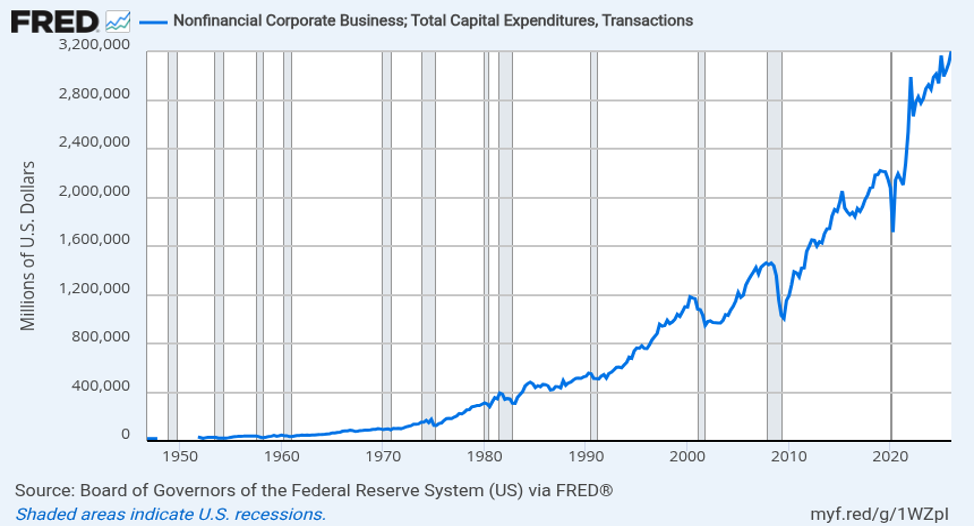
As the United States celebrates its 250-year anniversary, the world undergoes one of the most important technological transformations in history, one that will define the geoeconomic and geopolitical landscape for decades. Artificial intelligence is changing virtually all aspects of how we live, work, learn, and govern. Concurrently, the intensifying competition between the U.S. and China for AI leadership and global supremacy is redefining international relationships and global trade. While the impact of AI and global fragmentation are top of mind for investors, the U.S. is in the midst of a powerful capital expenditure super cycle that is offering market participants dynamic growth opportunities both in and beyond the technology sector. This super cycle is one of the most important and underappreciated investment themes for the next several years, and it defines many of the most meaningful investment opportunities. Since the COVID-19 pandemic, U.S. corporate capital expenditures have risen from $1.7 trillion to $3.2 trillion, up 88% in just six years, but this spending involves some of the most technologically sophisticated breakthroughs impacting manufacturing and scientific research. These investments also involve a renewed focus on protecting and growing the domestic economy, meeting exponentially increasing power demands, winning the battle for technological supremacy, and ensuring national security in a more dangerous world. Importantly, the combination of technological advances and reshoring of manufacturing are negating the low wage base advantage of Asian producers that led to the decline in U.S. manufacturing capability in past years.
Chart 1. Corporate Capital Expenditures – Will Companies Get Return on their Investments?
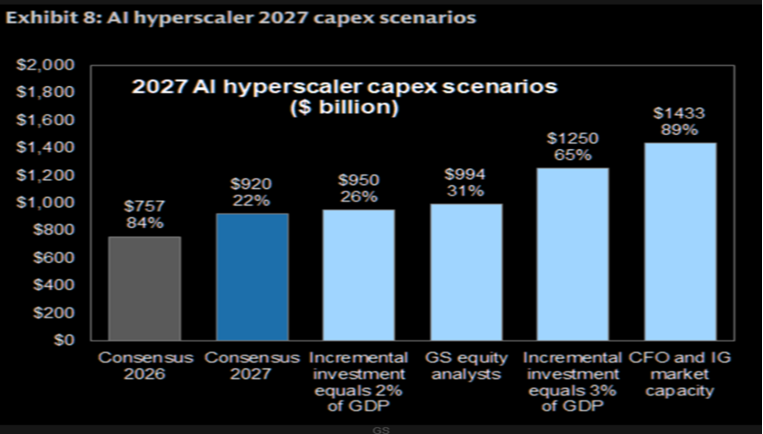
This current infrastructure buildout is unlike the 1999 tech bubble because it is the result of tangible demand of businesses and all levels of governments to satisfy both current and future needs of the U.S. economy. Satisfying these needs is generating significant profitability and profit margins for both new and old economy companies. The AI launch is unlike previous ones in the rapidity of its adoption, the speed and scale of the related investment, and its potential for disruption. At the same time, the U.S. requires rapid expansion of its electrical grid to meet the exponential growth of power demand. Global fragmentation is now driving spending increases for energy, critical resources, and national security to avoid future supply chain problems. The nation’s aging infrastructure also requires considerable additional investment with an estimated funding shortfall of over $4.5 trillion and rising over the next decade. Importantly, these opportunities are interconnected and self-reinforcing which makes the recent price moves of the companies that benefit both powerful and challenging, requiring investors to delicately balance between the risk of current volatility versus the longer-term opportunity. Even with all the hype around AI, a recent report from Goldman Sachs (Chart 2) suggests that the market may be underestimating the 2027 hyperscaler spend. Consensus estimates are for $920 billion in spending, whereas Goldman projects spending by hyperscalers could reach $1.2-1.4 trillion next year alone.
Chart 2. Goldman Sachs Report Suggests AI Hyperscaler Capex Too Low Despite the Hype
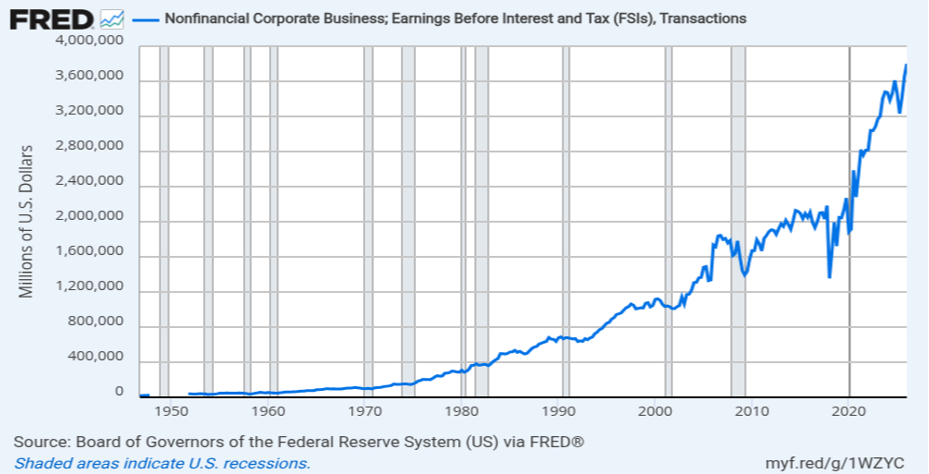
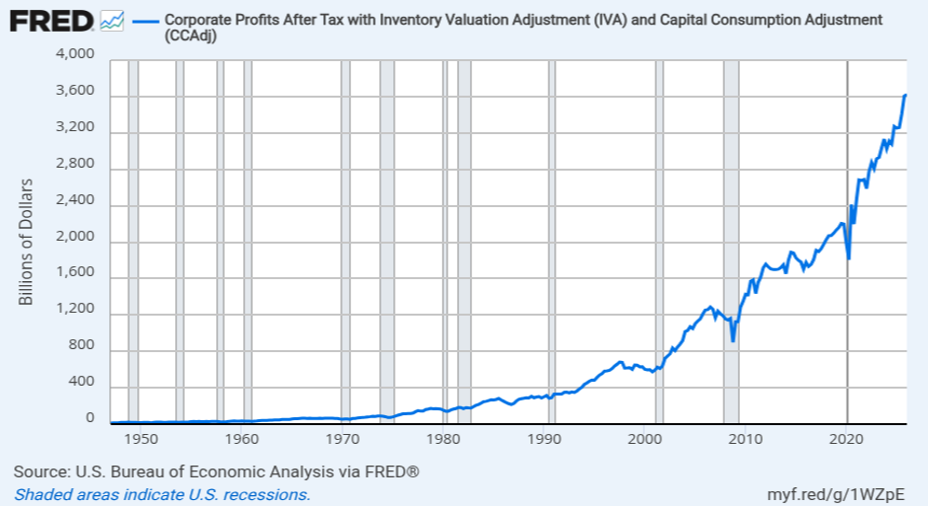
The debate on Wall Street is whether the investment in AI will see a suitable return. The answer will be based on companies showing continued strength in corporate earnings (Chart 3) and a realization of the promise that productivity improvements offset labor, inflation, and debt servicing issues weighing on sentiment. Since 2020, non-financial corporate earnings have doubled from $1.8 trillion to over $3.7 trillion. Some early adopters are already seeing the benefits of the substitution of capital for labor in both their earnings and margins.
Chart 3. As Spending Rose since 2020, U.S. Corporations Have Doubling of Earnings
The 3Ps – Why the Capex Cycle Matters
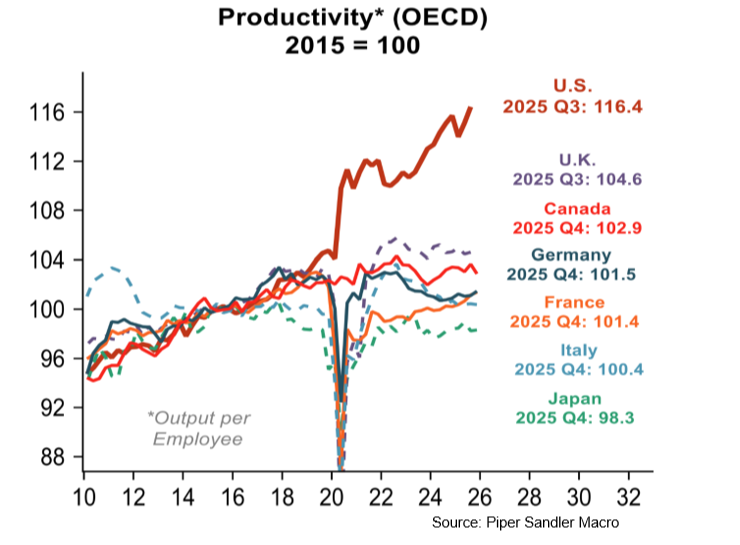
On a recent ARS conference call, Piper Sandler Macro’s Chief Global Economist Nancy Lazar spoke about the CapEx super cycle that is underway, and she highlighted the three big benefits of capital spending that she referred to as the “3Ps – increased productivity, profits, and potential GDP growth.” ARS has written about the importance of productivity for years and believes that the United States is about to see another surge in productivity. A labor shortage combined with skill mismatches are forcing businesses to increase technology spending. As companies invest to improve efficiency, this results in increases in profit margins and increases in hirings, while reducing the need to raise prices. The productive capacity of the United States is a strategic asset and has helped fuel our nation’s competitive advantage as shown in Chart 4. In 2019, most European nations matched the U.S. in terms of productivity but are now increasingly less productive. As an aside, this also works to increase the value of the dollar in international trade.
Chart 4. Comparing U.S. Productivity to That of Other Leading Nations
U.S. corporations are among the most adaptable in the world as evidenced by the fact that profits are over 80% higher than pre-COVID (Chart 5). Additionally, new business startups have been at record levels since the pandemic, and new businesses can use AI to achieve profitability more rapidly. Over time, every major technological advance has led to the creation of more jobs, and we see no reason for this one to be different. The combination of higher productivity and increased profitability results in higher potential GDP growth, allowing businesses to hire more workers and for workers to see real income gains.
Chart 5. U.S. After-Tax Profits Have Nearly Doubled Since Q1 2020
HOW ARS IS POSITIONING PORTFOLIOS HEADING INTO THE SECOND HALF
“Do not invest in the present. The present is not what moves stock prices.” –Stanley Druckenmiller, Legendary Investor
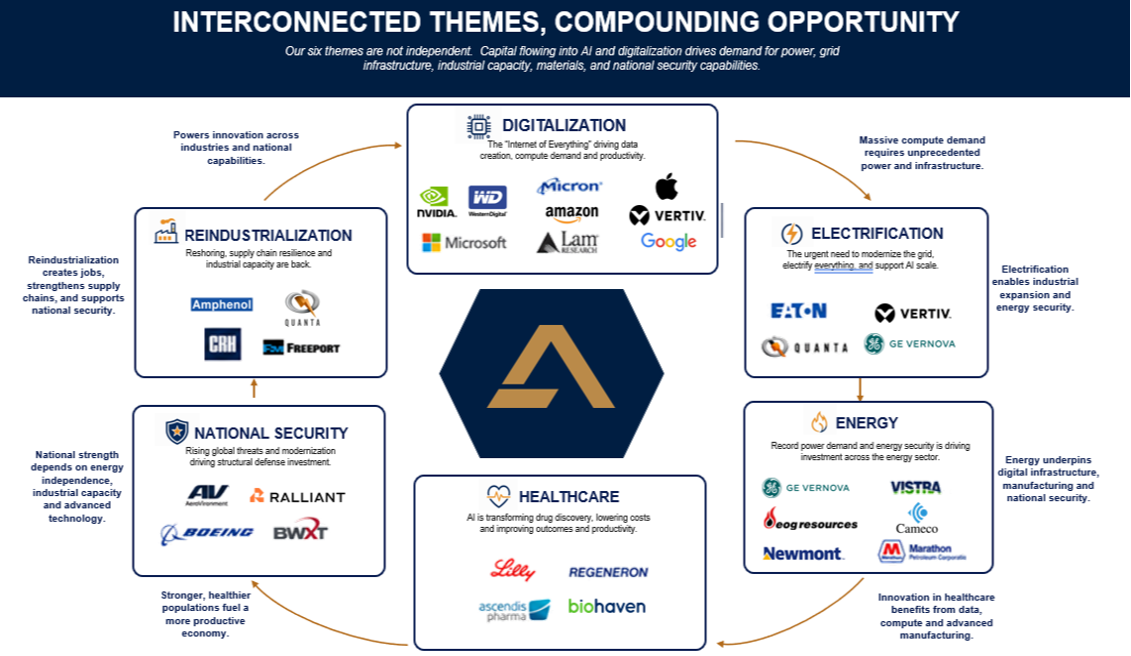
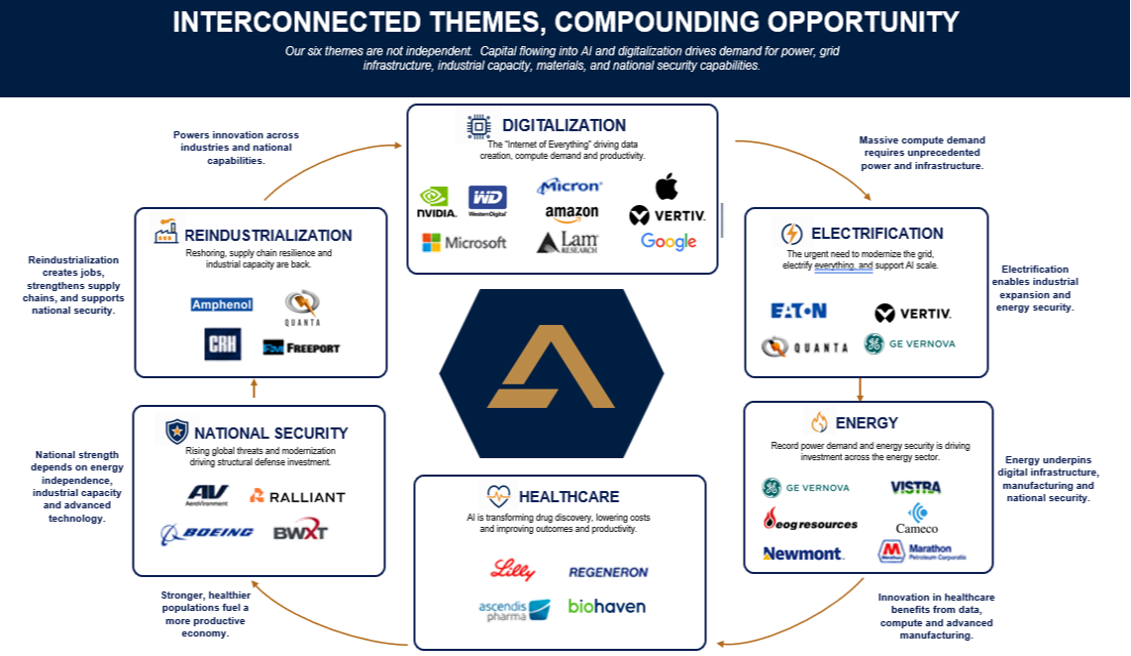
Investors are understandably confused by the stock market at new all-time highs given all the problems in the world today. The answer lies in the fundamentals of securities valuation which are the outlook for inflation, interest rates and corporate profits. Today’s capital spending is the driving force for controlling inflation, determining interest rates and corporate profits. Against the backdrop described above, ARS continues to find companies that are the beneficiaries of this super cycle in areas where most investors remain underinvested or are now just realizing the opportunity. Resource constraints help define some of the most interesting investments today, leading ARS to overweight the energy, defense, and materials sectors. The S&P 500 weighting of the energy sector is at 3.7%, the defense sector is near 2%, and the materials sector at 1.8% at time of publication, highlighting the critical mismatch given today’s reality. The focus for client portfolios has been, and continues to be, finding those companies that are the beneficiaries of the necessary capital spending whose revenues and earnings growth are being driven by multi-year supply and demand imbalances. This has the potential to provide them with strong pricing power for some time. Chart 6 highlights the six themes that are the focus for client portfolios and some representative holdings in each theme.
Chart 6. ARS Current Themes, Rationale, and Representative Holdings
Economic resilience and the entrepreneurial culture of the United States remain two of its most important competitive advantages. The nation’s history of adapting to past industrial and technological revolutions should give investors confidence that history will repeat itself. For investors, the enthusiasm for new, transformative technologies that often results in misallocations of capital and increased speculation can lead to significant investor losses in some sectors or industries as the software and private credit investors have learned this year, even as the intermediate and long-term winners are being recognized (think of select industrial, semiconductor and equipment names, among others). Transformational periods such as this are also the launching pads for many of the world’s most exciting new industries, businesses, products, and services. Today, a growing tension exists among investors between the promise of AI-driven growth and the reality of constrained resources in a world shaped by supply shortfalls.
The ARS Outlook For the Second Half and Beyond
“The greatness of America lies not in being more enlightened than any other nation, but rather in her ability to repair her faults.” –Alexis de Tocqueville
It is important to recognize that the U.S. economy will continue to be transformed and that this transformation will require considerable investment for many years. Artificial intelligence is the most profound driver of creativity and creative destruction since the Industrial Revolution. It will disrupt old jobs, business models, and geopolitics, but it will also improve productivity, create new jobs and industries, reduce healthcare costs, increase income outcomes, and increase longevity. Geopolitical fragmentation will force the global economy to be less efficient as nations work to secure resilient and reliable sourcing of critical materials to be self-sufficient. The wars in Ukraine and Iran have reminded governments that supplies of critical resources can be reduced or cut off as the world recently experienced on a greater scale with the Strait of Hormuz. There are seven other critical choke points for global trade that may become sources of future disruption, and the resolution of the Strait of Hormuz will be a key test.
Looking ahead, ARS sees continued elevated levels of uncertainty and individual stock volatility, particularly as we approach the end of the 60-day negotiation period for the cease-fire with Iran. Growth remains reasonably strong for the U.S. as GDP is on track to hit another record. Both headline and core inflation numbers remain well above the Federal Reserve’s 2% target, but the retreat in oil prices and a resumption of more normal trade could help ease inflationary pressures. Global central bankers are focused on achieving price stability after years of inflation running above target suggesting that interest rates will remain higher for longer. The world continues to run fiscal deficits which inevitably leads to the conclusion that well-selected businesses and not fixed income securities is the superior way to manage capital to protect against currency depreciation.
New Federal Reserve Chair Warsh has had a strong start in his tenure showing flexibility in his policy approach, a sharp vision for changes he would like to see for the Fed, and continued Fed independence. The Federal Reserve has shifted from an easing bias (cutting rates) to a tightening bias (raising rates), and the market now expects one or more fed funds rate hikes. ARS does not see the need at this time for a rate hike or cut and projects the yield on the 10-year treasury to be rangebound around current levels of 4.6%. Productivity and the relative strength of the labor market will be the key to Fed policy because the Fed’s mandate is full employment and price stability.
Both the demand for productivity-enhancing technologies and continued onshoring in manufacturing are raising capital spending dramatically and that spending will define the beneficiaries going forward. ARS sees strong earnings continuing for the beneficiaries but high volatility in individual companies remaining as business models may be enhanced or disrupted quickly as AI evolves. Even the perception of model impacts will sharply move prices, testing investors’ convictions and requiring deeper understanding of the shifting business and revenue models. A core economic strength of U.S. corporations is their ability to adapt to major economic or technological transformations and for the U.S. capital markets’ ability to provide the funding to finance these transitions.
Chart 7. Snapshot of the United States Economy – Leadership Requires Innovation and Investment
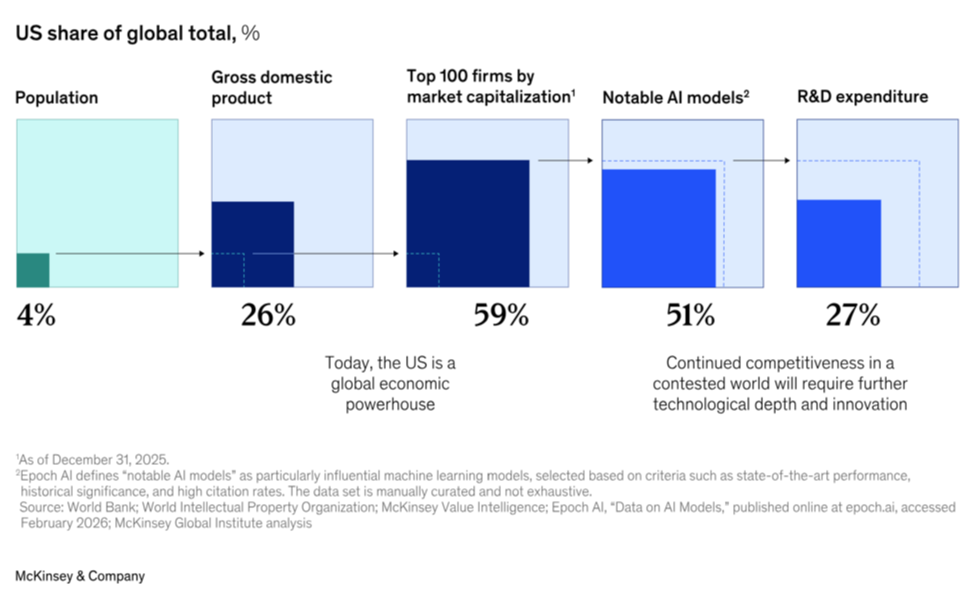
Notwithstanding the many social, economic, and political challenges facing the U.S. and global economies, the United States remains a magnet for capital flows and a place where people from all over the world seek to migrate. Not only does the United States attract immigrants, but the U.S. stock markets also continue to attract companies from around the world as our access to capital is unmatched. As shown in Chart 7, the United States is the most dynamic and productive economy in the world, but it cannot rest on its laurels. The U.S. is facing a very different world today than the post-WWII environment, and to maintain its position as a world leader it must continue to invest and innovate. As we celebrate our 250-year anniversary, it is easy to focus on the negatives in the country and the world, but we would caution investors not to be so pessimistic as we see a bright future for our nation and quality opportunities to protect and build capital in the coming years. We leave you with a quote from an old annual letter from legendary investor Warren Buffet about investing in the U.S., and we shared his optimism then as we do today.
“In its brief 232 years of existence ... there has been no incubator for unleashing human potential like America… Despite some severe interruptions, our country’s economic progress has been breathtaking. Our unwavering conclusion: Never bet against America.” –Warren Buffett, Legendary Investor
Published by the ARS Investment Policy Committee: Stephen Burke, Sean Lawless, Anthony Young, Greg Kops ,Andrew Schmeidler, Arnold Schmeidler, P. Ross Taylor, Tom Winnick.
The information and opinions in this report were prepared by ARS Investment Partners, LLC (“ARS”). Information, opinions and estimates contained in this report reflect a judgment at its original date and are subject to change. This report may contain forward-looking statements and projections that are based on our current beliefs and assumptions and on information currently available that we believe to be reasonable. However, such statements necessarily involve risks, uncertainties and assumptions, and prospective investors may not put undue reliance on any of these statements.
ARS and its employees shall have no obligation to update or amend any information contained herein. The contents of this report do not constitute an offer or solicitation of any transaction in any securities referred to herein or investment advice to any person and ARS will not treat recipients as its customers by virtue of their receiving this report. ARS or its employees have or may have a long or short position or holding in the securities, options on securities, or other related investments mentioned herein.
This publication is being furnished to you for informational purposes and only on condition that it will not form a primary basis for any investment decision. These materials are based upon information generally available to the public from sources believed to be reliable. No representation is given with respect to their accuracy or completeness, and they may change without notice. ARS on its own behalf disclaims any and all liability relating to these materials, including, without limitation, any express or implied recommendations or warranties for statements or errors contained in, or omission from, these materials. The information and analyses contained herein are not intended as tax, legal or investment advice and may not be suitable for your specific circumstances. This report may not be sold or redistributed in whole or part without the prior written consent of ARS Investment Partners, LLC.
Please email infor@arsinvest.com for a complete list of all holdings in ARS Investment Partners, LLC strategies.